How to set up the TopspinPro and the TopSpin Solution, plus five simple drills for kids and adult beginners. Short sessions, done often, work best.
As an Amazon Associate, Big NC earns from qualifying purchases.
We may earn a commission if you buy through these links, at no extra cost to you. (#ad)
A topspin trainer holds a ball in place so you can brush your racket up the back of it again and again. That brushing motion, starting below the ball and finishing above it, is the same low-to-high path that puts topspin on a real ball. You get lots of correct swings in a few minutes, then you take that feel to the rebounder or the court.
Our drawing: start below the ball, brush up the back of it, finish above it.
TopspinPro: setup and use
These steps follow TopspinPro's own printed assembly sheet and "How to use the TopspinPro" instructions. If your box has a newer sheet, follow that one.
Put it together
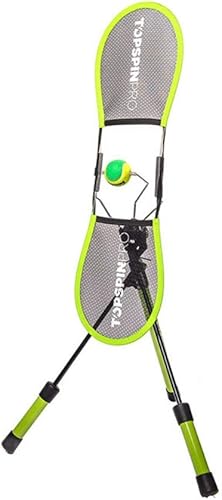
In the box: a tripod stand, the head unit with the ball, two fabric screen panels, a carry bag and a few spares.
Slide the thin front legs of the stand into the leg holders. The elastic inside guides them, and they go in about 2 cm.
Slide the square aluminum shaft of the head unit into the top of the stand, with the side that has the holes facing up.
Push the rods of the screen panels into the small holes in the screen holders.
Loop the elastics around the cleats so the screens stay put and the fabric is taut.
Our drawing of TopspinPro's assembly steps. Simplified, not to scale.
Adjust it and place it
Set the nut on the ball arm so the arm has a little friction. That slows the arm and keeps the unit from moving around. Don't tighten it so much that the arm stops moving.
Want the ball to push back a bit more? Loop the elastic around the locknut a couple of times.
Stand it on firm, flat ground in front of a line, with room to swing all around it.
Use the pin to set the height so the ball sits about at pocket height.
Our drawing of TopspinPro's adjustment and placement steps. Simplified, not to scale.
How to use it
Stand on the other side of the line from the trainer. For a one-handed backhand, stand about a shoulder width further back.
Use any normal forehand grip, wrist laid back, and meet the ball well out in front of your body.
The goal: make the ball spin without touching the screens. Swing past the ball at a slant and let the wrist work like a hinge.
Build it up: brush the ball with a flat hand first, then with the racket held shorter on the grip and loosely, then add a backswing, then a follow-through that ends with your hand near your shoulder.
Copy that same swing on a ball you drop yourself within 2 to 3 seconds, while the feel is fresh.
TopspinPro suggests a couple of minutes every day.
Our drawing, based on TopspinPro's "How to use" sheet.
Our drawing, based on TopspinPro's instructions: trainer in front of a line, ball at about pocket height, you on the other side. Simplified, not to scale.Our drawing, based on TopspinPro's instructions. For a one-handed backhand, stand about a shoulder width further back.Official video from the TopspinPro YouTube channel: Setting up the TopspinPro and How to use it. It is an older video, so if your model looks different, follow the sheet in your box.
From TopspinPro's safety notice: it is not a toy and is not suitable for children under 5, and children under 16 should be supervised by an adult. Never try to pull the fiberglass rods out of the screen panels. They are under tension and can spring out fast enough to hurt someone, especially their eyes.
These steps follow the TopSpin Solution instruction sheet from OnCourt OffCourt, the maker.
Hang it up
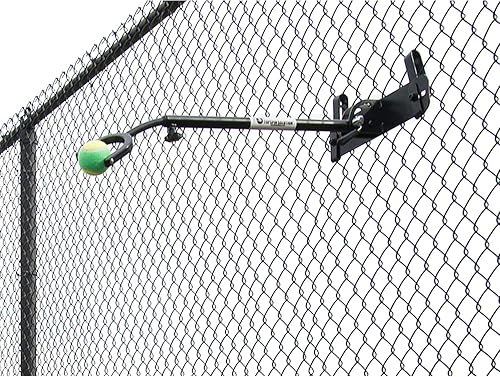
It is made to hang, at home or on a court. The photos on the maker's instruction sheet show it on a chain-link fence, a ball basket, a deck railing, a patio chair and a tennis net.
Pick a spot with room to swing and nobody walking past.
Angle the arm up for topspin practice. (Angled down, it is for slice groundstrokes, volleys and drop shots.)
Our drawing, kept generic. Hang it the way the maker's sheet shows for your spot.
How to use it
Start slowly to get a feel for it.
Try about 10 swings at a time. The idea is to feel how you create spin, not to swing hard.
To add footwork and balance, recover to a set spot between swings, then move back into position, on balance, for the next one.
The maker says you can also practice slice and kick serves, and suggests watching the videos on its website to see exactly how.
Our drawing, based on the maker's notes on reps and footwork.
Our drawing, based on the maker's photos: hung on a fence with the arm angled up for topspin. Their photos also show it on a ball basket, a deck railing, a patio chair and a tennis net.Official video from the OnCourt OffCourt YouTube channel, also shown on the maker's TopSpin Solution page: Topspin Solution.
Clear space: nothing within a racket and an arm's length of the swing, and siblings and pets well back.
Warm up for 2 to 3 minutes first: march, skip, arm circles and a few easy shadow swings.
Wear sneakers and stand on stable, dry footing.
Keep the TopspinPro on a flat, firm surface. Hang the TopSpin Solution only on something sturdy that doesn't wobble.
An adult supervises kids every time.
Stop if anything hurts, in the wrist, elbow, shoulder or back.
Our drawing: clear space all around, and an adult watching.
Five simple drills
Do 2 or 3 of these per session. Smooth swings beat hard swings. Kids means ages 5 to 12 with an adult watching.
1. Shadow forehand brush
Set up for a forehand. Start with the racket below the ball, brush up the back of it slowly, and finish with your hand up near your shoulder. Watch the ball spin.
Our drawing: start below, brush up, finish near your shoulder.
Kids: 2 sets of 10 Adult beginners: 2 to 3 sets of 12 to 15
2. Backhand brush
Same idea on the backhand side. Turn your shoulders, start low, brush up and through. One-handers on the TopspinPro stand a little further back.
Our drawing: turn, start low, brush up and through.
Kids: 2 sets of 10 Adult beginners: 2 to 3 sets of 10 to 15
3. Slow-to-fast reps
Each set builds speed: the first few swings in slow motion, the next few at medium speed, the last few at your normal swing. If the brush gets messy, slow back down.
Our drawing: build speed in each set.
Kids: 2 sets of 9 (3 slow, 3 medium, 3 normal) Adult beginners: 2 to 3 sets of 15 (5, 5, 5)
4. Eyes-closed feel reps
Line up, take a good look at the ball, then close your eyes and make one slow brush. Open your eyes and check the ball is spinning. Slow speed only.
Our drawing: look, close and brush, then check the spin.
Kids (8 and up): 2 sets of 5 Adult beginners: 2 sets of 8 to 10
5. Trainer to rebounder
Make 3 brushes on the trainer, then step over to the rebounder and hit one easy drop-hit forehand with the same swing, within a few seconds. See the rebounder drills on At-Home Training.
Our drawing: 3 brushes, then 1 easy drop-hit.
Kids: 2 sets of 5 (3 brushes plus 1 ball each) Adult beginners: 2 to 3 sets of 8 to 10
Rest about a minute between sets. Once the swing feels easy and stays clean, add a set before you add speed.
Topspin trainers
The two trainers used on this page.
Top pick
TopspinPro Tennis Training Aid
Helps kids groove a low-to-high topspin swing at home.
 Top pick